0000ZUTC

The Learn-Do-Fly Training Standard

For all who came here to fly

A free, open general aviation training framework by Rich Stowell, Master CFI-Emeritus, stewarded by Community Aviation. Edition 2.0 is coming soon.

Principles-based. Learning sciences-driven. Pilot-centric.

Coming soon

We're putting the finishing touches on v2.0 of the Standard. Leave your email and we'll let you know the moment it's ready.

About the Standard

A framework, not a curriculum

The Standard formalizes decades of practice, aligning with the Wright brothers' 1910 training model and ICAO's upset prevention and recovery framework. It forms the foundation beneath existing syllabi, instructors and schools. It's pilot-centered, measurable and free to adopt with no license. Formal certification is voluntary, and the Community Aviation platform is optional.

Flight schools

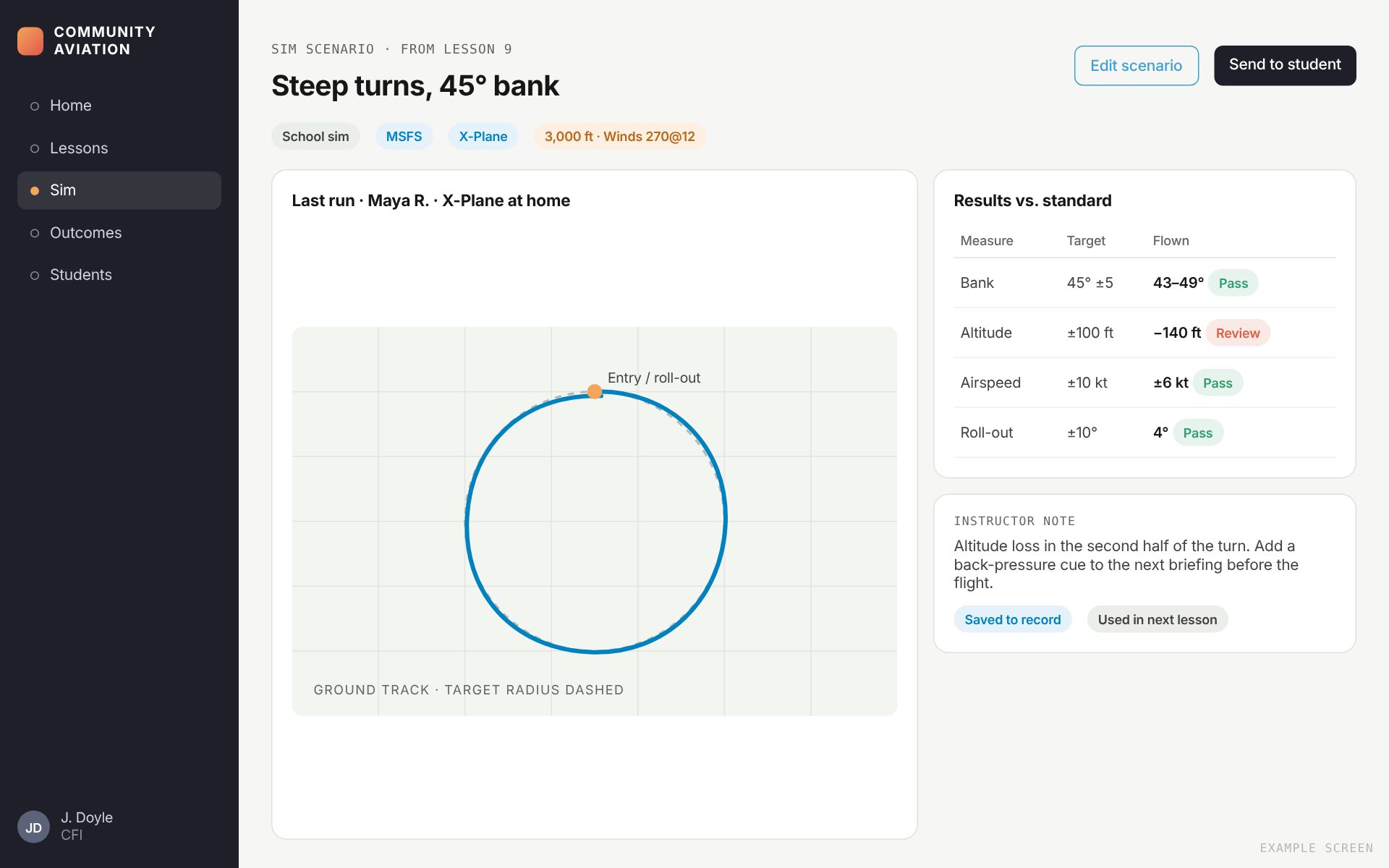
A shared framework, vocabulary and portable student records, so progress survives instructor changes.

Instructors

A repeatable lesson structure that still leaves room for your own judgment and voice.

Pilots

Training worthy of what you're preparing to do, and the vocabulary to recognize good instruction and ask for better.

Three building blocks

What every lesson is built from

01

The Nine Principles

A concise set of first principles from which all knowledge, maneuvers and tasks derive.

MindsetMotionMechanics

02

Learn-Do-Fly

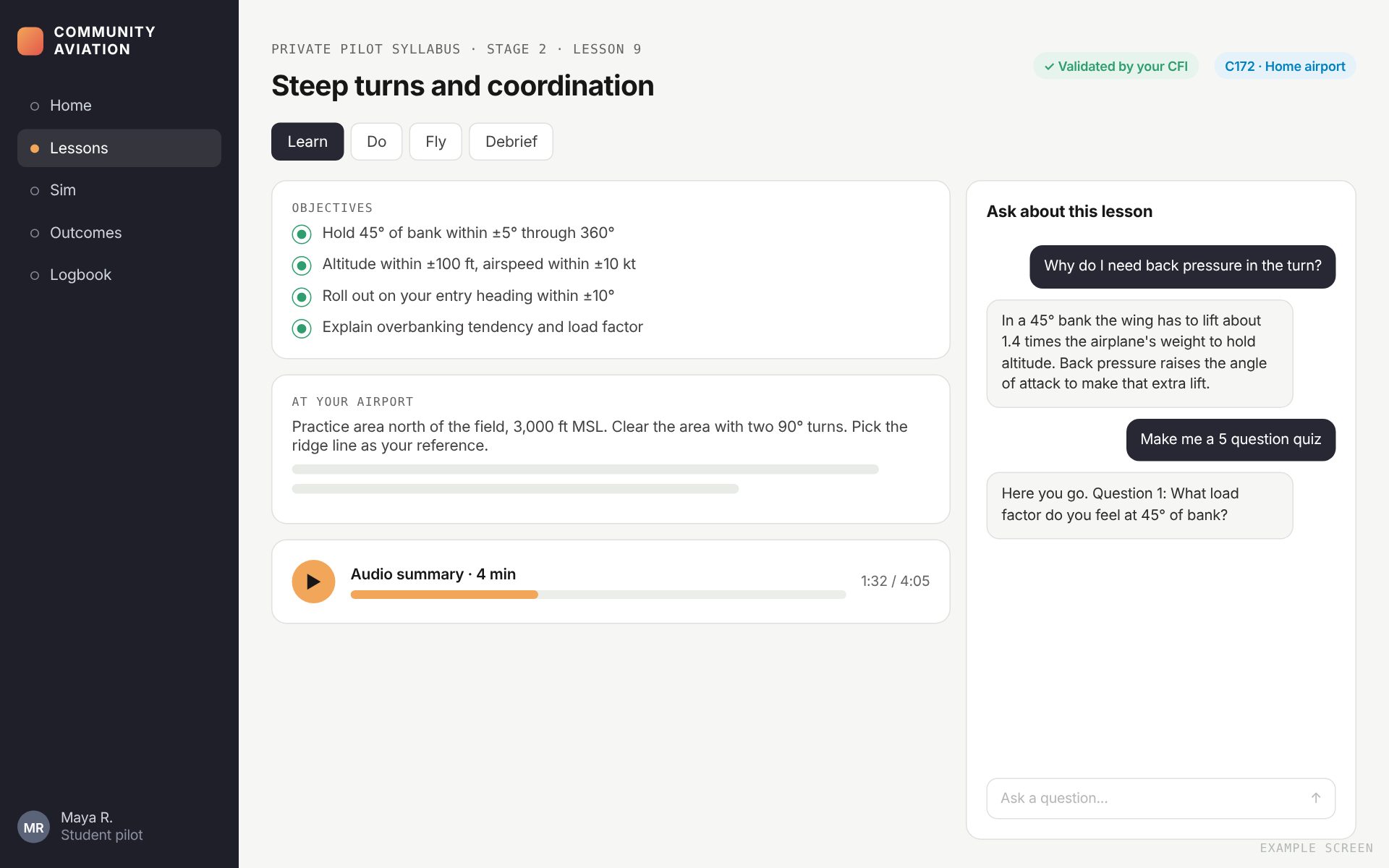
A three-phase optimal learning sequence. It separates understanding from skill rehearsal, then brings them together in the airplane.

  1. Learn
  2. Do
  3. Fly

03

The RUAC progression

Four levels of learning, with Correlation as the goal of training design, especially where safety-critical skills are involved.

  1. Rote
  2. Understanding
  3. Application
  4. Correlation

The foundation

The Nine Principles

It's your Mindset. You control the Motion. You manage the Mechanics.

Mindset

train intentionally · assess realistically · command effectively

  1. P1Pursue Optimal Learning Train with intention within the Learn-Do-Fly framework.
  2. P2Manage the Risk Identify and mitigate hazards, starting with the PAVE preflight checklist.
  3. P3Fly the Airplane Maintain control of the airplane above all else.

Motion

sense accurately · maneuver geometrically · plan accordingly

  1. P4Roll, Yaw & Pitch Control the airplane precisely about all three axes.
  2. P5Lines & Circles Visualize the geometry of every maneuver.
  3. P6Time & Distance Know how long and how far, on every flight.

Mechanics

act knowingly · operate confidently · manage skillfully

  1. P7Action-Reaction Connect every control input to its aerodynamic effect.
  2. P8Stalled Flight Recognize, prevent, recover, and learn from stalled flight.
  3. P9Energy Management Coordinate pitch, power, and configuration for the desired outcome.

What's in the document

Six parts

  1. 01

    The Principles

    The Nine Principles of Light Airplane Flying.

  2. 02

    The Framework

    Learn-Do-Fly, the RUAC progression and the learning sciences behind them.

  3. 03

    The Vocabulary

    The language of the Standard, presented as Word Walls.

  4. 04

    The Calls to Action

    How pilots, instructors, schools and organizations can adopt it over the next 12 to 24 months.

  5. 05

    The Stewardship

    Community Aviation's role, and an invitation to contribute.

  6. 06

    The Back Matter

    Appendices, including the mapping to the ACS, a glossary and a bibliography.

Editions and addenda

Versioned so anyone can cite and verify the edition they use. Edition 1.0 was published June 2, 2026. Addendum 1 numbered it and added a versioning and revision policy, and Edition 2.0 will absorb it. The Principles, the Learn-Do-Fly framework and the RUAC progression change only on evidence; other content is reviewed annually with outcomes published. Any pilot, instructor or training provider can challenge a statement, including anonymously, and every change is logged.

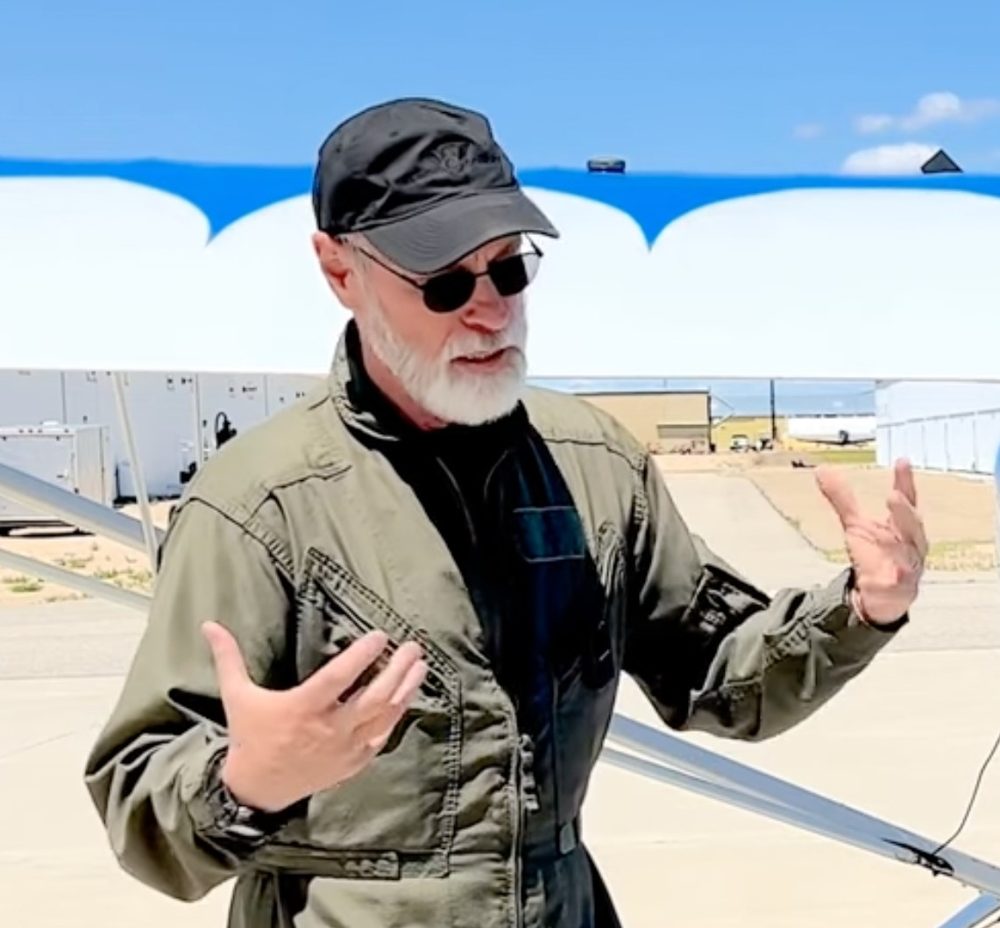
Rich Stowell

About the author

Rich Stowell

A full-time flight instructor since 1987 and creator of the Emergency Maneuver Training (EMT) Program. In 2001 Rich became the country's first Master CFI-Aerobatics. He is the 2006 National Flight Instructor of the Year and a Charter and Life Member of SAFE.

87%of participants in our 2024 Experiment in Optimal Learning at AirVenture were satisfied with the approach, 48% extremely so, versus 11% extremely satisfied with conventional training.

Also by Rich Stowell

The Nine Principles of Light Airplane Flying

The paper behind Part I of the Standard: the first principles of light airplane flying, organized into Mindset, Motion and Mechanics. Revised edition, February 2026. PDF and e-reader versions.

$7.95

Get the paper →

Learn to Turn

A free program on turning flight, built around the Lines and Circles principle. The booklet and the flight simulation exercises.

Free

Download free

The Knowledge Library

The foundation of the Knowledge Library

The Standard is the foundation of the Knowledge Library behind our learning platform. Every lesson the platform builds is grounded in it, alongside decades of master-instructor work and authoritative FAA sources.

Foundation

The Standard itself: the Nine Principles, Word Walls, the RUAC scale and the building blocks every lesson is made from.

Source works

Books, articles and papers by master instructors, transcribed, reviewed and cited.

Authoritative sources

FAA handbooks and the Airman Certification Standards, so what you learn traces back to its source.

For schools and instructors

See it on your syllabus

Share your syllabus. We'll audit it free, with an ACS coverage check, and then on a 15-minute follow-up call we'll show you one of your lessons enhanced with the Learn-Do-Fly Training Standard.

Book a 15-minute call →

Free to adopt. Get certified.

The full Standard is coming soon.